The 2026 FIFA World Cup is the largest single-event betting window the industry has ever faced. Thirty-nine days, 104 matches, three host countries, multiple overlapping time zones — and an industry whose fraud defenses are still organized around the wrong threat.
The tournament window is open. Operators who spent the past months hardening their front door are about to find out whether they were solving the right problem. Here are five predictions for how fraud will play out across the tournament window and where operators are likely to get caught.
1. Retention Fraud will Cost Operators More Than Acquisition Fraud
The industry’s World Cup fraud playbook centers on the welcome offer. Signup velocity caps, first-deposit checks, device fingerprinting at registration — these are mature controls that work reasonably well against opportunistic account creation.
The larger number will come from retention-stage abuse: aged accounts exploiting reload offers, loyalty tier bonuses, VIP promotions and event-specific campaigns that only long-tenure players qualify for. In a 2026 SEON survey of 332 betting and gaming fraud, risk and compliance leaders, bonus abuse, loyalty fraud and account takeover together accounted for 68% of reported fraud losses. Two of those three categories are, by definition, retention-stage problems.
Operators planning for a signup spike are solving last tournament’s problem.
2. The Fraud Surge Started Before Kickoff
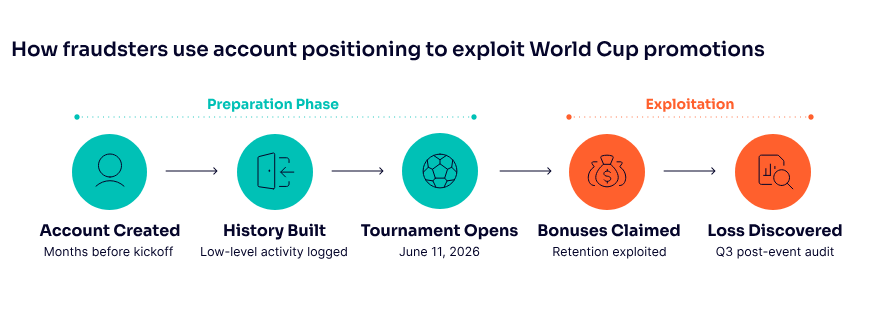
Fraudsters will not wait for the opening whistle. The most valuable asset during a major event is not a fresh account — it is an aged, well-behaved account that qualifies for retention-stage promotions without triggering additional scrutiny.
Account positioning (creating or acquiring accounts and maintaining low-level legitimate activity to age them past onboarding review windows) is a preparation phase, not an event-time tactic. By the time the first match kicks off on June 11, the accounts that will cause the most damage will already have months of clean transaction history.
Fraud teams that scheduled their tournament response for June are already behind.
3. Reactivation Campaigns Will Be the Highest-Risk Promotional Channel
Dormant account reactivation is a standard CRM play before a major tournament: push a win-back offer to players who went cold, bring them back for the event. The problem is that dormant accounts are also the most common entry point for account takeover.
The SEON survey found that account takeover represents 27% of reported fraud losses in iGaming. A meaningful share of that volume comes from reactivation flows, where operators actively push incentives to accounts they have not verified since the original onboarding. The player who “comes back” for the World Cup may not be the player who left.
Operators running reactivation campaigns without re-scoring returning accounts against current behavioral and device signals are funding their own fraud exposure.
4. Multi-Market Promotions Will Create Fraud Patterns That Operators Can’t Trace
The 2026 World Cup spans three countries and 16 host cities. Operators licensed in multiple jurisdictions will run coordinated promotional campaigns across markets — and fraudsters will exploit the seams.
Multi-accounting clusters that span jurisdictional boundaries are harder to detect because the data often resides in separate compliance stacks. A player flagged for suspicious behavior in one market may hold clean, active accounts in another, claiming retention bonuses against different promotional budgets with no cross-reference.
The 55% of operators who told SEON that data visibility across the customer lifecycle is “extremely” or “very” challenging will feel that gap acutely during a multi-market, multi-week tournament window.
5. Post-Tournament Fraud Audits Will Uncover Losses Operators Didn’t Know They Had
The worst outcome is not the fraud you detect during the World Cup. It is the fraud you discover in the Q3 finance review — losses that looked like normal promotional redemption during the tournament but reveal themselves as abuse once the volume normalizes.
Among operators surveyed, 57% reported fraud losses growing faster than revenue. That gap does not appear overnight. It accumulates across campaign cycles, disguised by the same engagement metrics marketing teams use to justify retention budgets. The tournament’s surge in legitimate activity will provide even more camouflage than usual.
Operators that report retention bonus performance gross — without netting out fraud losses from the same campaign — will not know the real cost of their World Cup promotions until weeks after the final match.
The Structural Gap Behind All Five
Each of these predictions traces to the same organizational assumption: that onboarding is the fraud verdict and retention is a marketing function. That split made sense when the industry’s biggest exposure was at signup. It does not hold when 68% of reported losses come from abuse that happens after the player joins.
The operators who come out of the 2026 World Cup with margins intact will not be the ones with the best pre-match fraud rules. They will be the ones whose fraud and marketing teams share the same data — and who built the infrastructure to act on it before the tournament opened.
Frequently Asked Questions
The tournament runs from June 11 to July 19, 2026, and is hosted across the United States, Mexico and Canada. For operators, the fraud-relevant window extends weeks before kickoff as fraudsters position accounts in advance of event-driven promotions.
Most operators already have reasonable acquisition-stage controls. Retention-stage abuse targets the promotional infrastructure accessible only to longer-tenure accounts, produces recurring losses across campaign cycles, and hides within engagement metrics that appear healthy in summary reports.
Re-evaluate whether onboarding data connects to retention-stage behavior signals. Involve fraud analysts in the design of promotional campaigns, including mid-tournament offers, not just pre-event terms. Ensure reactivation campaigns re-score returning accounts rather than treating original KYC as a permanent pass.
Account positioning is the practice of creating or acquiring accounts and maintaining minimal legitimate activity over weeks or months to build a clean history. Positioned accounts qualify for retention-stage promotions without triggering the kind of velocity or behavioral alerts designed to catch new account fraud.
Synthetic identities will appear in signup volumes, but operators with mature onboarding controls are increasingly equipped to catch them. The larger unaddressed exposure remains retention-stage abuse by accounts that passed KYC with real or high-quality fraudulent documents months ago and now operate inside the promotional system unchallenged.